
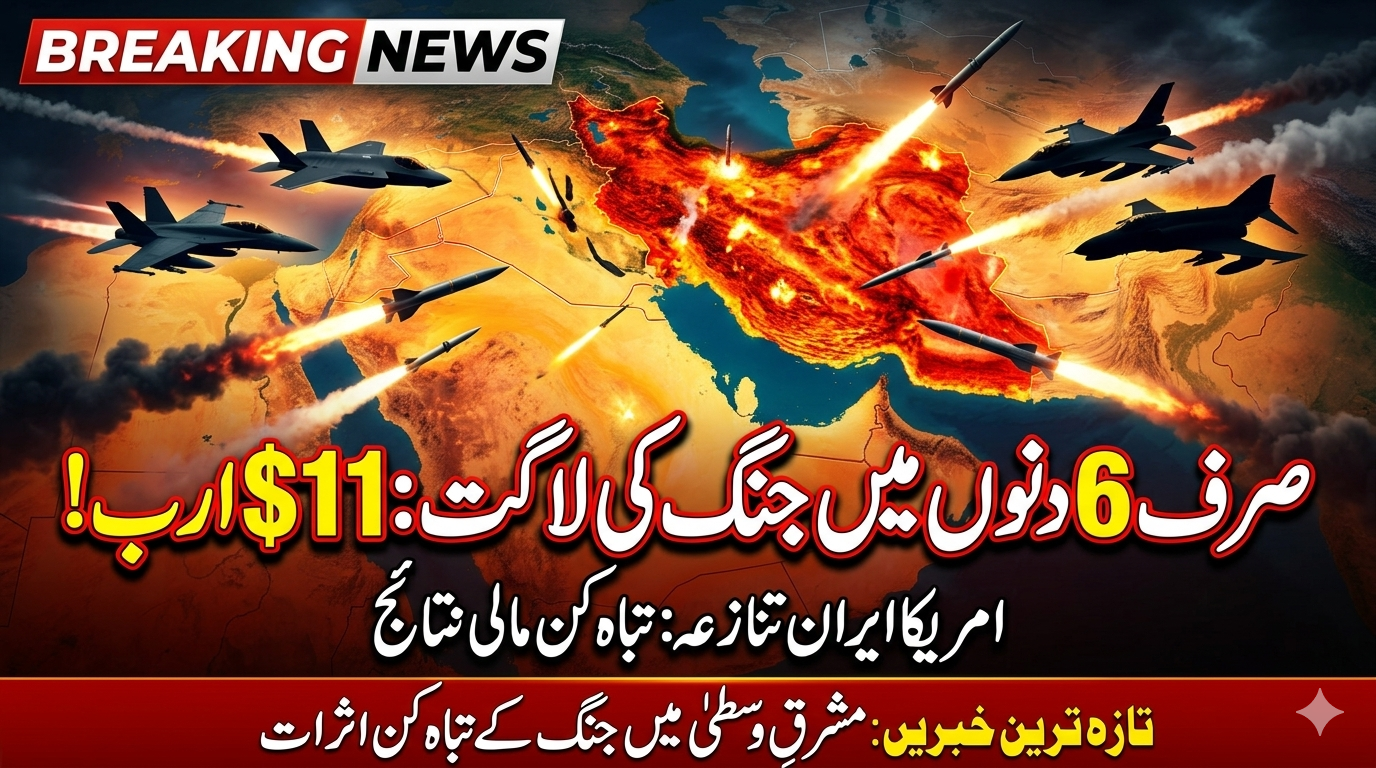
The Staggering Price of Conflict: Analyzing the Estimated $11 Billion Cost of the First Six Days of the US-Iran War
The newly implemented Pakistan IT Export Policy 2026 is a game-changer for the country’s digital economy, aiming to boost tech exports and support freelancers.
WASHINGTON D.C. / TEHRAN – The geopolitical landscape of the Middle East has been thrust into chaos, and the financial toll is already setting unprecedented records. According to a striking estimate from a US government briefing, the first six days of active fighting in the conflict with Iran have cost the United States over $11 billion (approximately $1,833,333,333 per day).
This figure, if accurate, represents an astonishing rate of military expenditure, far surpassing the daily average of other protracted US conflicts like those in Iraq and Afghanistan. This analysis breaks down where this immense capital is likely being deployed, the immediate strain on the US economy, and the potential long-term global consequences.
Also read
https://ehsaasbispinfo.com/punjab-electric-…iendly-transport/
1. The $11 Billion Breakdown: Where is the Money Going?
Modern warfare is an incredibly capital-intensive endeavor, defined by advanced technology, rapid deployment, and a vast logisitical trail. Military analysts suggest that $11 billion in just six days implies a massive, full-spectrum kinetic operation. The briefing’s estimate likely covers several high-cost categories:
Precision-Guided Munitions (PGMs): Iran’s sophisticated integrated air defense systems require high-cost weapons to neutralize. A single Tomahawk cruise missile costs approximately $2 million. Hundreds of these, along with Joint Direct Attack Munitions (JDAMs) and other smart bombs, could account for billions of dollars in expenditure within the initial “Shock and Awe” phase.
Rapid Force Deployment and Logistics: Moving thousands of troops, armored vehicles, aircraft, and naval strike groups into the theater is a Herculean (and expensive) task. The cost of fuel alone for aircraft carriers, jet fighters, and transport planes is immense. Establishing and maintaining supply lines for ammunition, food, and medical support runs into the hundreds of millions daily.
Naval Operations and Sea Control: Securing the Persian Gulf and the Strait of Hormuz involves multiple carrier strike groups and amphibious ready groups. Operating a single aircraft carrier costs roughly $6.5 million per day; operating several simultaneously, while actively engaged in combat, scales this cost exponentially.
Cyber Warfare and Intelligence: The conflict features a significant digital front. Offensive and defensive cyber operations, continuous satellite surveillance, and unmanned aerial vehicle (UAV) missions require substantial high-tech resources and specialized personnel.
2. Immediate Economic Strain: The US Domestic Impact
An unbudgeted $11 billion expenditure in less than a week places immediate and severe strain on the US fiscal framework.
The US National Debt Clock:
The US is already managing a record national debt exceeding $34 trillion. This war expenditure is entirely deficit-funded. Economists warn that if this rate of spending continues, it will drastically increase the federal budget deficit, potentially triggering concerns about debt sustainability. This could pressure the Federal Reserve regarding interest rates and inflation management.
Domestic Priorities vs. War Funding:
Every dollar spent on the war is a dollar not available for other domestic priorities, such as infrastructure development, education, or healthcare. If the conflict becomes prolonged, the government may be forced to choose between further increasing the national debt or cutting funding for critical social programs—a politically contentious decision.
3. Global Consequences and Market Reactions
The conflict is not contained; its economic ripples are felt worldwide, primarily through the energy sector.
Oil Price Volatility:
Iran’s strategic location gives it the ability to threaten the Strait of Hormuz, a critical maritime chokepoint through which 20-30% of the world’s total oil consumption passes. The outbreak of fighting immediately caused oil prices to spike. Military analysts fear that any physical disruption to oil tankers in the strait could send global crude prices to unprecedented levels (potentially above $150 per barrel), triggering a global energy crisis.
Global Economic Recession Risk:
A prolonged energy crisis, combined with the general instability caused by the war, significantly increases the risk of a global economic recession. High energy costs translate to increased transportation and manufacturing expenses for all goods, driving up global inflation and stifling economic growth.
Reference Links (For Further Analysis)
This analysis is based on estimates from the US government briefing and reports from credible military and economic analytical organizations. For more detailed information, please consult the following resources:
US Department of Defense (DoD): defense.gov – Official statements regarding military operations and expenditures.
The White House: whitehouse.gov – Information on war-related budget requests and diplomatic efforts.
Reuters: reuters.com – Real-time coverage of the conflict and market reactions.
The Economist: economist.com – Deep-dive analysis on the global economic consequences of the war.
Costs of War Project, Brown University: watson.brown.edu/costsofwar – Historical data and analysis of the long-term costs of post-9/11 US conflicts.
Official Updates & News
Beneficiaries are advised to follow official sources for the latest announcements:
Punjab Government Official Website:
🔗 https://punjab.gov.pkWhatsApp Updates:
🔗 https://whatsapp.com/channel/0029Vb7MYua0gcfLWzto2T01Facebook Page:
🔗 https://www.facebook.com/share/1Aaye4dKkC/
Frequently Asked Questions (FAQs)
Q1: How accurate is the $11 billion estimate? This figure comes from an official US government briefing. However, precise war costs are often fluid and classified. Analysts consider this an “order of magnitude” estimate reflecting an extraordinary rate of active combat expenditure.
Q2: Does this $11 billion cover the total cost of the conflict? No. This figure only covers the first six days. Protracted wars have massive long-term costs, including care for wounded veterans, replacement of military hardware, and reconstruction aid, which can total trillions of dollars over decades.
Q3: Is this expenditure higher than other modern conflicts? Yes. For perspective, at the height of the wars in Iraq and Afghanistan, the estimated combined cost was roughly $300 million to $500 million per day. A cost of $1.8 billion per day reflects an intensity of high-tech kinetic warfare not seen in recent decades.
Q4: How does this war affect my daily life if I am not in the conflict zone? The primary impact will be felt through energy prices. A conflict involving a major oil producer like Iran, especially one that threatens crucial shipping lanes, will almost certainly lead to higher prices at the gas pump and increased costs for consumer goods worldwide.
Q5: Can the US afford to sustain this level of spending? The US has the economic capacity to fund this in the short term, but sustaining a rate of $11 billion every six days would be unprecedented. Long-term, it would require significant shifts in national priorities, including potentially cutting domestic programs or increasing taxes