
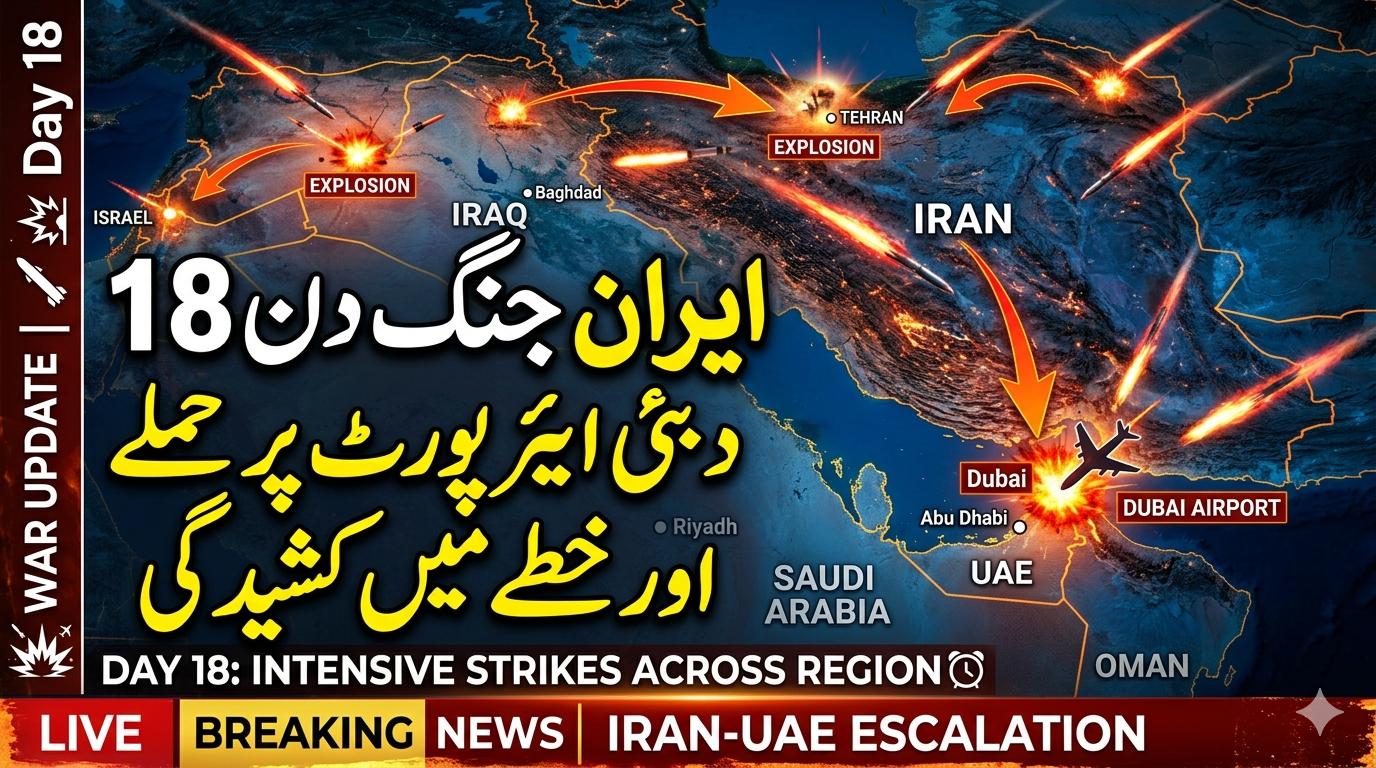
Iran War Enters Day 18: Escalation Across the Middle East with Attacks Near Dubai Airport and Regional Spill‑Over
The Iran War 2026 has reached its 18th day, continuing as one of the most dangerous and wide-ranging conflicts in the Middle East in recent decades
The 2026 Iran war has reached its 18th day, continuing as one of the most dangerous and wide‑ranging conflicts in the Middle East in recent decades. The war — sparked by a surprise U.S. and Israeli air campaign against Iran on February 28, 2026 — has expanded into multiple fronts, involving missile and drone strikes, international military responses, extensive civilian and infrastructure damage, and severe global economic impacts.
Also read
https://ehsaasbispinfo.com/pakistan-tax-fre…ar-import-scheme/
Origins of the Conflict
The current phase of hostilities began when the United States and Israel launched coordinated surprise attacks on key Iranian military and leadership sites, including strikes that reportedly killed Iran’s Supreme Leader and senior commanders. These initial strikes, intended to degrade Iran’s capacity for missile and drone warfare, instead triggered a massive Iranian retaliation.
Since then, Iran has responded with waves of ballistic missiles, cruise missiles, and unmanned aerial vehicles (UAVs) targeting U.S. forces, Israeli territory, and Gulf states. According to official regional defense sources, Iran has launched hundreds of strikes against the United Arab Emirates (UAE), leading to multiple deaths, injuries, and infrastructure damage.
Recent Developments: Gulf Attacks and Airport Disruption
One of the most significant developments in the last 24 hours was a drone strike that disrupted flights at Dubai International Airport, one of the world’s busiest aviation hubs. At least one terminal fuel tank was hit, triggering a fire that temporarily halted air traffic before operations gradually resumed under strict safety protocols.
This was the third known incident at Dubai’s airport since February 28, demonstrating the campaign’s persistent threat to civilian infrastructure and international travel.
In addition to Dubai, the United Arab Emirates reported interception of multiple ballistic missiles and drones, though debris from these interception efforts has caused secondary damage and civilian casualties in residential and commercial zones.
Regional Spread of the Conflict
The war has spilled far beyond Iran’s borders:
Baghdad and other Iraqi regions have seen sporadic drone or missile activity, including attacks near the highly fortified U.S. Embassy district.
Commercial airlines are altering routes or temporarily suspending services due to airspace closure and safety concerns: Oman Air has announced cancellations affecting major international destinations until March 31, while Air India has diverted flights within the UAE.
Military and Leadership Targets
Israel has ramped up its aerial operations, claiming killing two senior Iranian officials — including Iran’s top security official — in overnight strikes targeting command infrastructure. Israeli political and military leadership describes these as blows to Tehran’s capacity to continue prolonged strikes. Iran, however, continues to vow retaliation without formally acknowledging the deaths.
Wider Military Toll
The human cost of the conflict extends to U.S. forces as well. Reports indicate that over 200 U.S. troops have been wounded across seven countries — including Bahrain, Iraq, Jordan, and Saudi Arabia — mostly from Iranian missile and drone attacks. Several deaths have also been recorded from both hostile action and an American refueling plane crash in Iraq.
Economic and Global Impacts
The ongoing conflict has severely disrupted global aviation and energy markets:
Oil and gas prices surged sharply as attacks on Gulf energy infrastructure and the near‑closure of the Strait of Hormuz — a crucial transit point for global crude — disrupted supplies.
Thousands of international flights have been cancelled or rerouted, impacting global travel patterns and raising costs for airlines and passengers alike.
Diplomatic Strain and Regional Responses
Global reactions have been mixed. While the U.S. calls for naval deployments to protect strategic waters, several allies have been hesitant to commit forces. Regional powers like Saudi Arabia and Qatar have expressed frustration with lack of prior warning before major military actions, highlighting growing diplomatic strains within the allied coalition.
Looking Ahead
As the war enters its third week, there are no clear signs of immediate de‑escalation. Military analysts suggest both sides remain committed to offensive actions, and the spread of the conflict into neighboring states increases risks of further escalation. Continued international diplomatic efforts are ongoing but have thus far failed to halt the fighting.
For real‑time context on how these developments unfold, see the ongoing coverage of the 2026 Iran war at Wikipedia:
🔗 2026 Iran war – comprehensive background and current status: https://en.wikipedia.org/wiki/2026_Iran_war
Follow for Daily Updates
Stay updated with the latest petrol prices, government schemes, and breaking news.
Facebook Page
https://www.facebook.com/share/17zB3qoEKA/WhatsApp Channel
https://whatsapp.com/channel/0029Vb7MYua0gcfLWzto2T01
Frequently Asked Questions (FAQ) – Iran War 2026
Q1: What triggered the current Iran war?
A1: The war started on February 28, 2026, when the U.S. and Israel launched coordinated airstrikes on Iran, targeting military and leadership sites. Iran retaliated with missile and drone attacks across the Middle East. (Wikipedia)
Q2: Which countries are directly involved?
A2: The main participants are Iran, the United States, and Israel. Neighboring countries, including UAE, Iraq, and Bahrain, have experienced attacks or debris fallout, affecting civilians and infrastructure. (Al Jazeera)
Q3: Are civilians affected by the conflict?
A3: Yes. There have been civilian casualties and injuries in the UAE and Iraq due to missile and drone debris. Airport closures have also disrupted thousands of travelers. (Times of India)
Q4: How has the conflict affected global energy markets?
A4: Oil and gas prices surged as attacks targeted Gulf energy infrastructure and raised fears of supply disruptions through the Strait of Hormuz, a key oil transit route. (The Guardian)
Q5: Has there been any international diplomatic intervention?
A5: Diplomatic efforts are ongoing, including EU calls for peace and attempts by Gulf countries to mediate. However, no immediate ceasefire has been achieved, and both sides remain in active conflict. (Reddit geopolitics discussion)
Q6: How long is the war expected to last?
A6: Analysts indicate that fighting may continue for weeks given both sides’ military capabilities. Escalation risks remain high due to regional involvement and retaliatory attacks. (Wikipedia)
Q7: What should travelers and residents in the Gulf do?
A7: Authorities recommend avoiding conflict zones, monitoring airline updates, and following official safety instructions due to missile and drone threats. (Al Jazeera