
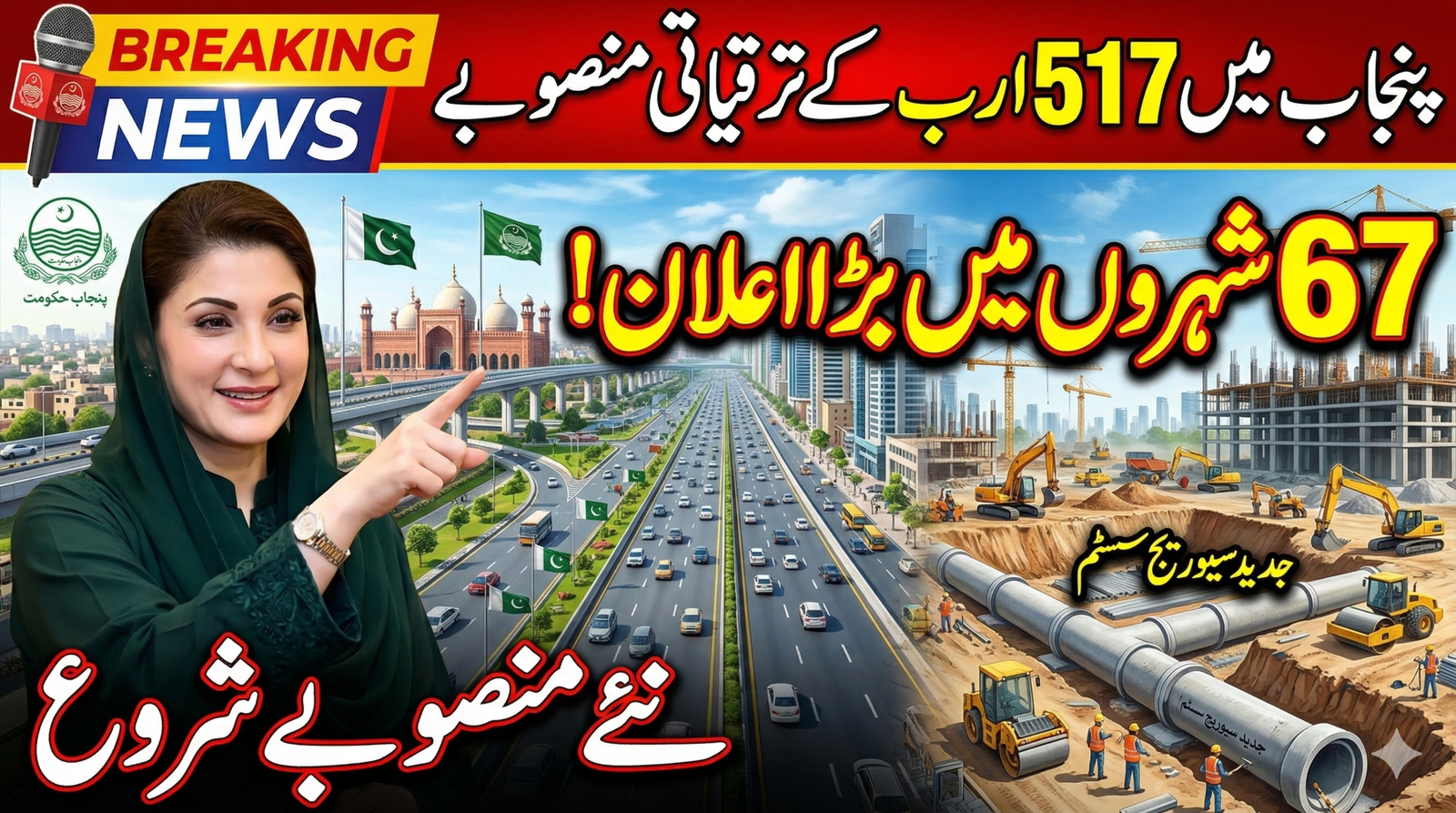
Driving Progress: Punjab Government Unveils Rs 517 Billion Development Mega-Projects Across 67 Cities
The provincial government has embarked on an unprecedented journey of modernization and public welfare with the announcement of the Punjab Rs 517 billion development projects. Under the leadership of Chief Minister Maryam Nawaz Sharif, the provincial administration has allocated this colossal budget for widespread development spanning 67 cities. Detailed recently by Information Minister Azma Bokhari and Local Government Minister Zeeshan Rafique, this initiative aims to decentralize development, ensuring that rural areas and smaller municipalities receive the same critical attention as major metropolitan hubs.
This multi-billion rupee investment is not just a structural upgrade; it is a holistic approach to elevating the standard of living, enhancing public health, and stimulating the grassroots economy across the province.
Also read
8070 Muft Atta Program 2026: Online Registration & Rs 10,000 Cash
Vision for Uniform Development
Historically, major infrastructure and transit projects in Punjab were heavily concentrated in key metropolitan cities like Lahore, Rawalpindi, and Faisalabad. However, the current governance model marks a strategic pivot. The administration’s vision is explicitly focused on uniform, province-wide development.By actively directing funds and focus toward 67 cities—including numerous small towns and rural settlements—the government is bridging the urban-rural divide. The strategic intent is to transform rural areas into “model villages,” thereby curtailing forced urban migration and providing high-quality civic amenities to citizens right at their doorsteps.
Vision for Punjab Rs 517 billion development projects
Massive Infrastructure & Civic Upgrades
At the core of this Rs 517 billion outlay is a desperate need to overhaul aging civic infrastructure. The Local Government Ministry has rolled out a comprehensive master plan to resolve long-standing water, sanitation, and hygiene (WASH) issues. Key infrastructural highlights include:
Extensive Sewerage Networks: The government is laying down an astonishing 2,265 kilometers of new sewer lines across 6,100 specific locations to drastically reduce sanitation-related diseases.
Wastewater Management: To ensure environmental sustainability, 328 modern wastewater treatment plants are being constructed. These plants will help in cleaning ponds and ditches that have long been health hazards in rural settings.
Disposal Stations & Drainage: The plan includes the construction of 130 new disposal stations and 189 kilometers of reinforced water drains to facilitate smooth water flow and prevent waterlogging.
Combating Urban Flooding and Water Scarcity
With climate change causing erratic monsoon patterns, urban flooding has become a recurrent nightmare for Punjab’s densely populated cities. To combat this, the provincial government is constructing 358 underground water tanks.
These tanks serve a dual, highly effective purpose. First, they act as reservoirs to rapidly clear rainwater from streets, thereby eliminating urban flooding. Second, they conserve this rainwater to help replenish and improve the rapidly depleting groundwater levels across the province.
Punjab Rs 517 billion development projects
Financial Transparency and e-Tendering
A common critique of mega-projects in developing regions is the leakage of public funds through inefficiencies. The Punjab government has addressed this head-on by strictly enforcing a transparent e-tendering process.
Information Minister Azma Bokhari confirmed that this digitization of the procurement process has already resulted in massive savings of Rs 13 billion. This fiscal prudence ensures that every rupee allocated is effectively utilized for public welfare rather than being lost to administrative friction.
Welfare Initiatives: The Nigehban Ramadan Program
Infrastructure development is only one side of the coin; immediate public relief is the other. Running parallel to these structural mega-projects is a massive social safety net.
As part of the Nigehban Ramadan Program, the Punjab government has distributed over 2.5 million relief cards to vulnerable households, with over 2.1 million beneficiaries having already withdrawn financial assistance. Furthermore, the administration arranged official Iftar tables at 422 locations and established 1,763 stalls in designated bazaars, providing substantial relief to the masses amidst inflationary pressures.
Punjab Rs 517 billion development projects
Conclusion
The Rs 517 billion development package is a watershed moment in Punjab’s governance history. By merging massive infrastructural upgrades with transparent financial practices and robust social welfare programs, the government is setting a new benchmark for provincial administration. If executed on schedule, these projects across 67 cities will not only modernize Punjab’s landscape but will also significantly boost public health, economic activity, and the overall quality of life for millions of citizens.
Follow for Updates
Follow for daily scheme updates:
👉 WhatsApp Channel:
https://whatsapp.com/channel/0029Vb7MYua0gcfLWzto2T01
👉 Facebook Post/Page:
https://www.facebook.com/share/1Aaye4dKkC/
Frequently Asked Questions (FAQs)
Q1: What is the total budget allocated for the new development projects in Punjab?
The Punjab government has allocated a massive budget of Rs 517 billion for ongoing infrastructure and development projects.
Q2: How many cities are included in this development program?
The development initiatives span across 67 cities in Punjab, focusing heavily on uniform growth for both small towns and rural areas rather than just major metropolises.
Q3: What major infrastructure improvements are planned?
Key improvements include laying 2,265 km of new sewer lines, building 328 wastewater treatment plants, 130 new disposal stations, and constructing 358 underground water tanks.
Q4: How has the government saved money during these projects?
Through the implementation of a highly transparent, digitized e-tendering process, the Punjab government has successfully saved Rs 13 billion.
Q5: What is the Nigehban Ramadan Program mentioned alongside these projects?
It is a massive social welfare initiative under which over 2.5 million relief cards have been distributed to provide financial assistance and subsidized goods to vulnerable citizens.